

Blog
Hope in a basket

Sometimes a random thought will strike me and I will head to Facebook – the uber-depository of all random thoughts – to fling it out into cyberspace and see what comes back by way of comment. A couple days ago, after walking past the overflowing Missing in Action Sock Basket, I wondered aloud on Facebook what would happen if I just chucked the whole thing. I mean, really. Why do I keep those unpartnered socks month after month after endless month? What law is written in the heavens that demands I keep bachelored socks forevermore? What cataclysmic event do I hold at bay by keeping Unmatched Socks?
This is what I posted, expecting maybe one comment from my mother and perhaps one or two facebook friends:
What would happen if I just dumped the missing socks basket into the trash and didn’t look back? How long do you let a mateless sock pine away after its AWOL partner? I think I’ve been too generous. . .
That post is now at 46 comments. This staggering amount of opinions knocked my socks off, if you get my drift. I was unprepared for so many kindred hearts out there who struggle with the weighty moral issue of what to do with lonely socks. And amazed by those who’d thrown caution to the wind and tossed them, fates be darned, into the Abyss. Here are some of the most telling responses, warnings and woe-is-mes:
- From Cynthia: When you dump the missing sock basket in the trash, the others will turn up.
- From Marcia: I’m sure the world would stop spinning on its axis. That’s why I have a pile of them still in my drawer!
- From Leslie: Let ’em go, Susan. Let ’em go. It’ll feel so freeing, I promise!
- From Brett: I actually have some in storage. But I am a firm believer in what Cynthia says…
- From Kris: Use them as dust rags before you throw them away.
- From:Bill: Don’t do it!!!! You’ll unleash forces beyond your knowledge! Save them! You MUST SAVE THEMMMMMM….
- From Sean: Maybe their match is lying in our basket?
- From Tim: I used to sit for hrs every Monday, after doing the laundry on the weekends, matching socks while watching evening TV. I found a few mates, had a sock war with my kids, and put the lonesome soldiers back in a bag for next week. Finally through most of them away, and purchased matching white socks for my three teen ge boys and myself. Made life simpler, but I missed the sock fights.
- From Julie: Do it!
- From Nora: Where do the socks go??? I took two off and put them in the hamper and then where do they go?? Do I really want to know??
- From Amy: I think about doing this ALL the time!!!!!
- From Donna: Get rid of them, don’t look back!
- From Leah: I have tempted fate oh so many times. I throw socks away like candy wrappers.. . Somehow I don’t have the heart to tell them they don’t have a chance at finding a sole mate . . .
- From Bob, my husband: Wait, I put all my singles in my sock drawer until I find it’s partner…we have a basket?
Do you sense what I sense here? What’s the deal with so many passionate opinions about socks that have lost their mates and therefore their purpose? Socks are forever being stripped of their usefulness by The Evil Twins (washer and dryer, of course) and yet we keep them, long after we’ve learned to get along just fine without them. .
We keep them because we have a vision of restored usefulness. We can imagine a day when what was lost is found. That’s called hope.
It’s not such bad thing to have one little nook in your life where hope rests. I walk past that basket every day. My little basket of hope. . .
I might keep the sock basket after all to remind myself ala Churchillian optimism that the day you give up on hope is a sad day.
Might.
Remarkable Rhubarb
 |
| Rhubarb Upside Down cake. Mmmmmm |
Sometimes I wonder how kitchen delectables come about, especially when the raw materials aren’t so tasty on their own. Taste a raw cacao bean and you’ve got to ponder who had the genius to suppose that if you mash it up with sugar and butter and milk you get awesome chocolate. Same with rhubarb. Someone had to imagine those gorgeous stalks that look like celery on its way to Cinderella’s ball but taste like her fireplace could be redeemed with massive amounts of sugar and strawberries.
I didn’t grow up with rhubarb in my backyard – don’t think it grows too well in SoCal’s Mediterranean climate – but I was around it a lot during my fourteen year-sojourn in the Midwest. Minnesota rhubarb defies elements that would kill an orange tree in one day flat, coming back hale and hearty every year out of a frozen, 6-month-long coma. Amazing stuff.
Its leaves are elephantine-large and its stalks are a lovely ballet-pink that turn crimson in the long days of summer. My kids had free range to the neighbors’ rhubarb plants when they were little. They would break off a stalk, come into the house to pour a saucer of sugar to dip it in and manage to sprinkle most of the kitchen with crunchy granules. Ah, summer memories!
We ate a lot of strawberry-rhubarb pie – my favorite – and rhubarb slush – omigosh so good – and I do miss it now that we are back in San Diego.
This weekend, I went to the grocery store and bought several batons of rhubarb, very pretty though not fresh from the ground, and made rhubarb upside down cake. Yum yummy.
I am glad there are kitchen wizards who look at a thing that tastes pretty snarky on its own and who wonder, “What if?”
Keep the magic coming. . .
Always learning
Spent the better part of the day at UCSD yesterday, as a guest of my retired high school English teacher, Frank Barone, watching as he awakened the imaginations of daycampers at writing camp. I have some pictures to share with you and an awesome quote from one of his students, but first things first, we need to announce the winner of Broken Wings by Carla Stewart. Thanks to random.org, the lucky recipient is Stephany! Dear Stephany, email me at susan [at] susanlmeissner [dot] com so we chat about a mailing address. Thanks to all who commented. If you didn’t win, do get your hands on the book. Carla is a gifted storyteller. And now for the pictures.
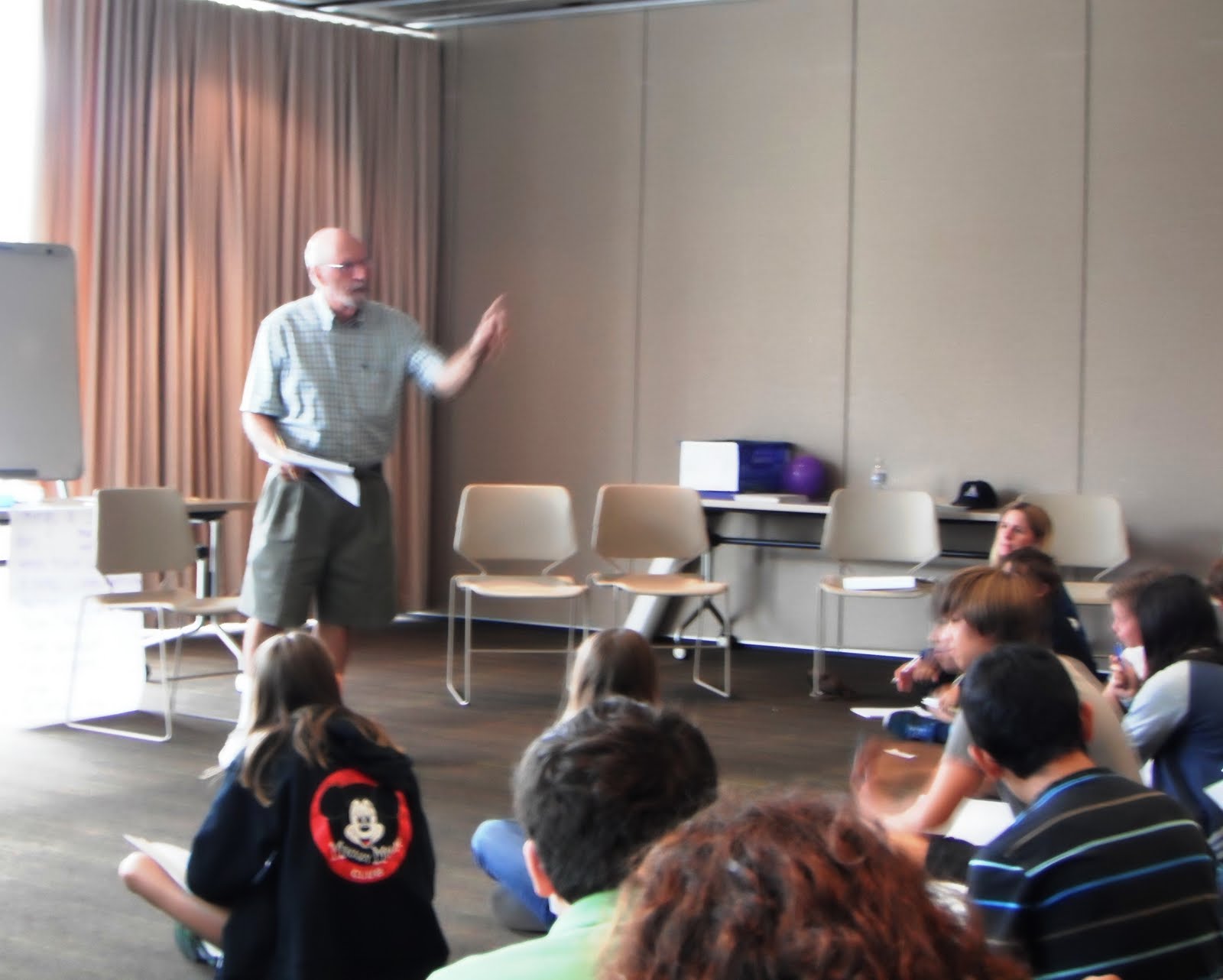 |
| Back in 1975, when he was Mr. Barone to me, Frank affirmed me as a young writer capable of being published one day. He honestly thought it was possible. Good thing I believed him. It took twenty-five years to truly take him at his word, but his remembered faith in me propelled me. Here he is addressing young writers who reminded me of me. |
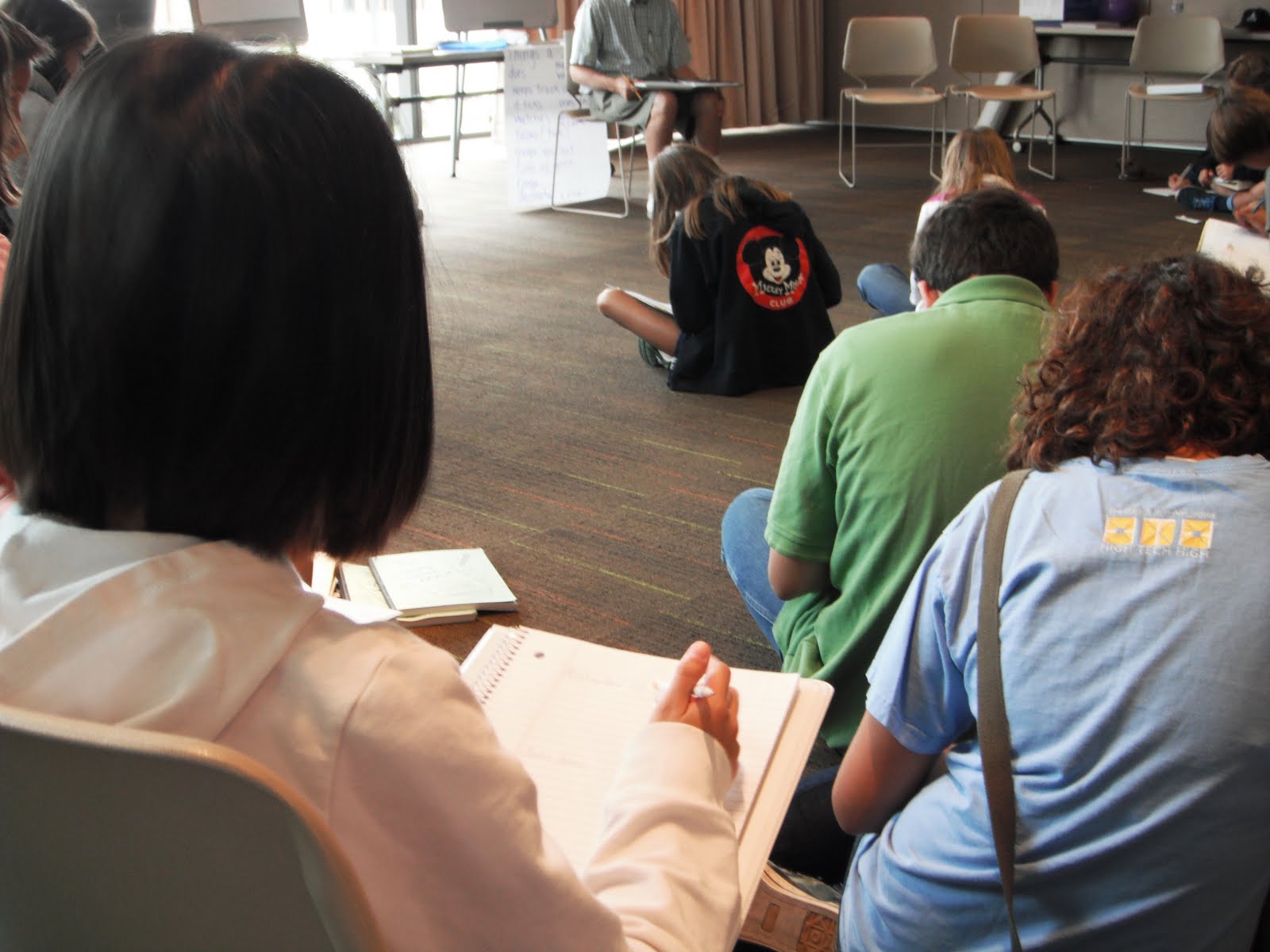 |
| The students are writing a poem. First, Frank held up a purple balloon and asked them what they saw. Not a purple balloon, but what the purple balloon wooed them to see. A sunset. A giant grape. A happy raindrop. |
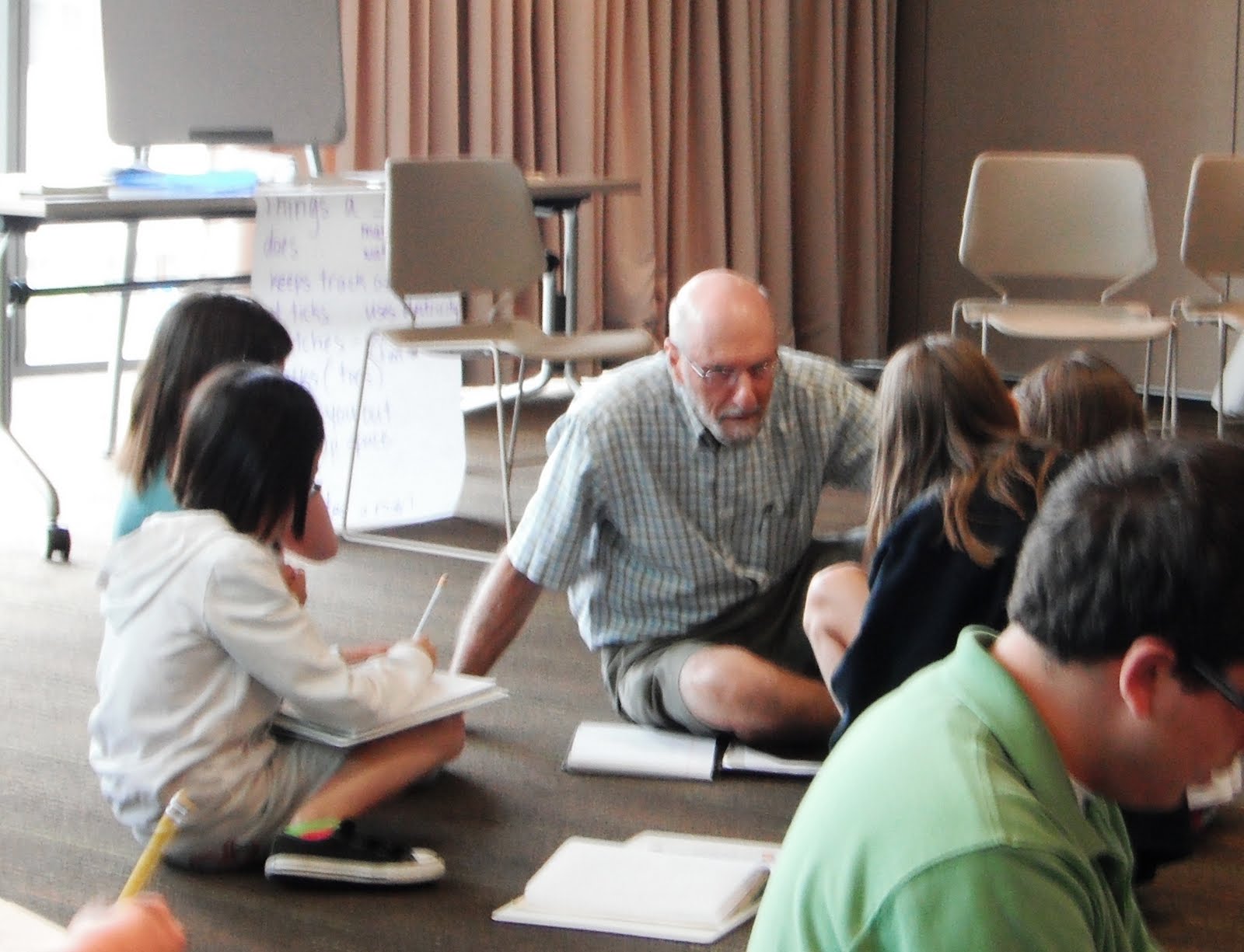 |
| Here he is coaxing creativity out of them. When he asked the students to share what poetry is like, one girl said (and I love this) “Poetry is like music. It is not a song, but it sings to you.” Love that. |
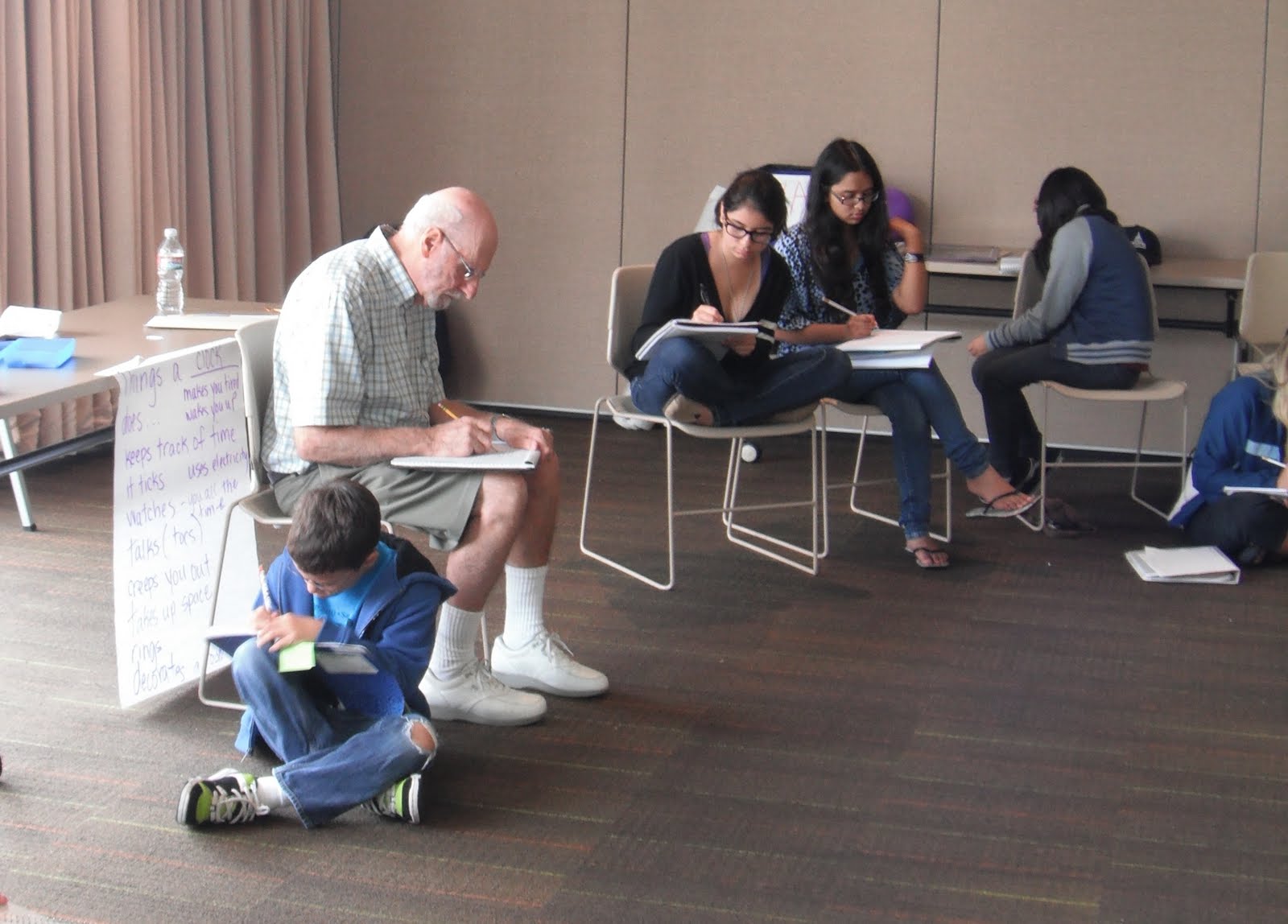 |
| Writing a poem with his grandson, Charlie. Cool kid. |
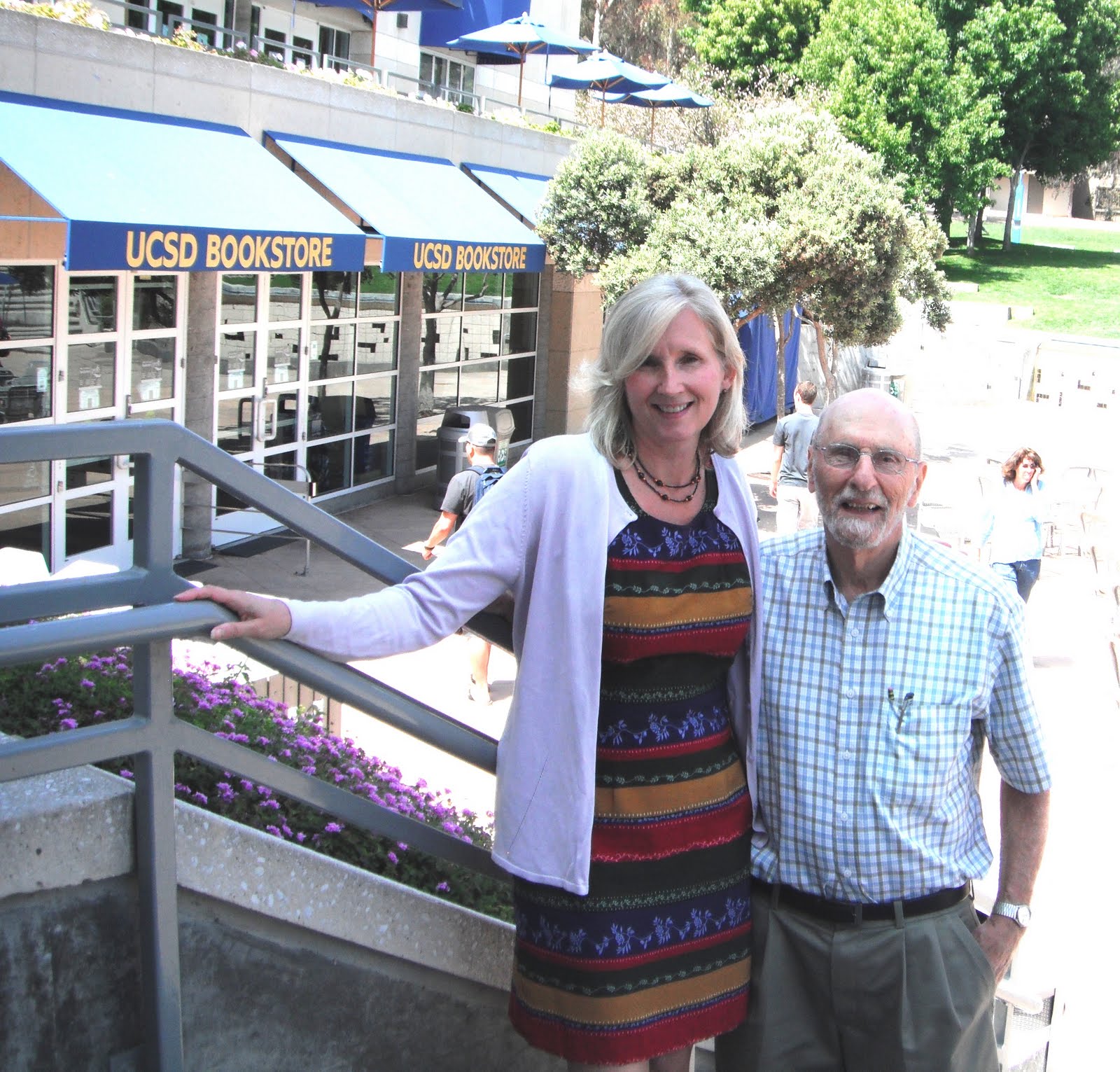 |
| Frank and I. Student and teacher. Mentor and mentee. Writer and writer. Friend and friend. |
Monday chat with Carla Stewart

Today at Edgewise I am happy to have as my guest a good friend and fellow writer, Carla Stewart. Her second book, Broken Wings has just hit the streets to great reviews. Carla’s debut novel, Chasing Lilacs, was stunning. Truly. When I read it I knew she was on her way to a great career in fiction. I encourage you to read them both! You won’t be disappointed. And I encourage you to read to the end of this blog post.
Because you don’t be disappointed there, either.
Broken Wings centers around two women. Mitzi Steiner is the second half of a singing duo that captured America’s heart for more than two decades. But now Mitzi’s beloved husband is disappearing into the nether world of Alzheimers, leaving Mitzi alone and pondering. On the other side of Tulsa, Brooke Woodson has met the outwardly perfect man — a handsome lawyer with sights on becoming Tulsa’s next District Attorney. But his drive for success comes with a nasty side effect. He channels all his anger over his own disappointments onto Brooke. Onto her heart and onto her body. An accident lands Brooke in the hospital where Mitzi volunteers, and the two women develop an unlikely friendship. With Mitzi’s kindness and insights, Brooke learns how to pick up the broken pieces of her life.
So let’s get right to the heart of Broken Wings.
Edgewise: Where did this story spring from?
Carla: It began with a short story I wrote a number of years ago based on my own family’s tales about the Great Depression and Black Sunday in particular. In “Sand Plum Summer,” three orphans were taken in by a farm family when their mother perished in the worst dust storm in history.
I loved this story and thought of the characters from time to time. It was almost like they were waiting backstage for their cue to make an entrance. It kept coming back to me that the oldest of those three orphans surely had a story to tell. Then one day I read a newspaper article about the possible renovation of Tulsa’s Big Ten Ballroom, a jazz hall in the forties and fifties. I knew at once my little orphan had grown up to become a jazz singer. She would be quite elderly now, of course, but perhaps she needed to tell her story. Once I had a starting place and Mitzi in mind, the plotting and story took off from there.
Edgewise: Who are you most like in the story, Mitzi or Brooke? Carla: Definitely Mitzi who made mistakes, sometimes foolish ones, but kept pushing forward. Being rooted in faith from an early age gave Mitzi a compass for her life, and I’ve had the same. Even when I veer from the path, God is always on the shoulder of the road guiding me back.
I do have a bit of Brooke in me—striving to please people and afraid of saying or doing the wrong thing.
Edgewise: What did you learn about yourself in writing Broken Wings?
Carla: That I’m not always the kind of friend I would like to be. I know there are those who might have welcomed a meal when I was wrapped up in edits or marketing. I have a neighbor who I used to have coffee with regularly, and now that writing demands more of my time, we go out only once in a while. I’ve been examining some of the restraints that writing has put on my relationships and resetting priorities. Words shouldn’t take precedence over people.
Edgewise: Did you learn anything new about God?
Carla: I came to this story with only a glimpse of how I could make the scenes from the past intersect with the contemporary ones. And even as I wrote each new section, I felt the hand of God guiding my fingers, giving me just the right words and characters to tell this story, not only of friendship, but also grace. His grace became new to me all over again, and I was reminded that He is sufficient in all things.
Edgewise: What was it like doing research for this one?
Carla: I visited the Jazz Depot in Tulsa which is home to the Oklahoma Jazz Hall of Fame. I attended concerts there and read articles and books about the rich jazz culture that is part of Tulsa’s heritage. Very fun! I already had a folder of material on Alzheimer’s so I reviewed it, researched current articles, and relied on my past experience as a nurse to bring the character to life. The Alzheimer’s research became very personal when my mother-in-law was diagnosed with mid-stage Alzheimer’s less than a month after Broken Wings was contracted. She’s a beautiful lady, and it’s been sad to see her spiral deeper into the tangles of this dreadful disease.
But the most challenging part of the research was learning about abuse which, thankfully, didn’t come from such a personal connection. I studied the personality types of victims and abusers and read a lot of personal stories and case studies. I also found the DSM-III (Diagnostic and Statistical Manual of Mental Disorders) helpful in understanding the personality of an abuser.
Edgewise: I struggle to understand women who stay in abusive relationships because I just would not do it! Did you have to work through any preconceived notions of your own in the writing?
Carla: That’s a tough question because I came to the writing knowing it would be a struggle, but I also knew that, for me, abuse is intolerable. What I didn’t expect, though, was how angry it made me toward abusers, and I had a bit of anger, too, at the victim (Brooke in the story) for being so naive and willing to deny that the abuse was going on. While I knew that abuse is often passed down or learned, every individual can choose the behaviors they exhibit. Abusers are frequently respected and get along in many areas of life and choose those who they can intimidate. They can also choose to seek professional help. Sadly, many don’t.
It was not a comfortable story to write, but I don’t know that I’m excused from writing about hard things just because they make me squirm.
Edgewise: What do people need to know about domestic abuse that you discovered while writing this book?
Carla: It is much more common than I ever imagined, but there are usually warning signs that begin before actual abuse takes center stage—irrational behavior, disdain for authorities, getting hot tempered over trivial things, blaming others for their behavior, wanting to be in control of the relationship. The most alarming statistic that I read was that 40% of teens age 14-17 had either been abused or knew someone who had while in a dating relationship. If anything, I hope Broken Wings gives courage to women who are in abusive relationships, that they will realize that it’s not their fault nor their responsibility to stay with an abuser because he “needs” her. Victims, too, have a choice. Help is available, and I included resources at the end of the book as a place to start.
Edgewise: What’s next on the horizon for you?
Carla: Stardust (FaithWords) will be out early next summer. It’s lighter in tone, but still has some knotty issues. I’ve returned to a nostalgic time and found some real characters in the bayou country of East Texas. The year is 1952 at the height of the polio epidemic. Here’s a thumbnail sketch:
The Stardust Tourist Court beckons an East Texas widow to a new life, but when her dead husband’s mistress arrives and polio strikes, Georgia Peyton’s dreams are crippled.
Thanks for having me at the Edge, Susan!
Susan here. It’s been a pleasure to have Carla here! And now for a giveaway!! Post a comment here on the blog or on the Facebook post where this link appears and your name will be in the mix for a copy of Broken Wings! A random winner will be drawn at 9 a.m. Pacific on Friday, July 29!
Have a great week, everyone!
We have a winner!
Thanks to random.org, we have a winner for Mary DeMuth’s new book, The Muir House! Congrats to musingsnprint. You are the lucky winner! Send me a shout-out at susan [at] susanlmeissner [dot] com and we will get the House into the mail for you. Thanks to all who commented. If you didn’t win, be sure to get the book another way. You will be glad you did.
I am headed out to North Carolina in the a.m. to teach on the secrets of an unforgettable story at the SheSpeaks conference. I am so looking forward to sharing with a roomful of storytellers what makes a story stay with us long after we’ve turned the last page.
I won’t be blogging on Friday, but I have a treat for you on Monday. Another interview with another amazing novelist and another book giveaway! Come back to the Edge on Monday to see who it is!
Cheers . . .
Friday chat with Mary DeMuth
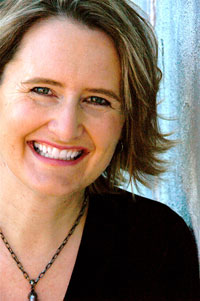 Today I welcome to the Edge the dearest of friends, Mary DeMuth, so that we can chat about her new novel, The Muir House. Mary is a gift to me; she is a master wordsmith, wise about so many things, and truly loves God with all her heart. It is always a pleasure to welcome her here. Her latest work of fiction, The Muir House, is set in her current hometown, Rockwall, Texas, and centers around a house and woman with memories hidden inside it. (Stay tuned! Giveaway details at the end of the post!)
The main character, Willa, returns to Rockwall, Texas, after turning down a marriage proposal to a great guy. Something in her past prevents her from being able to say yes and she is compelled to find out what it is. She journeys to Muir House Bed and Breakfast, a former funeral home. From the publisher’s description: “But the old place holds her empty memory close to itself. Willa’s mother utters unintelligible clues from her deathbed, and the caretaker of the house keeps coveted answers carefully protected. Throw in an old flame, and Willa careens farther away from ever knowing the truth. Set in a growing suburb of Texas, The Muir House explores trauma, healing, love new and old, and the life-changing choices people make to keep their reputations intact.”

Edgewise: Where does the name Muir House come from?
Mary: From my brain. Actually I did a little research on the word “wall” and found Muir to be a variation of that. Le mur is a French word, meaning The Wall. There is a house redecoration metaphor throughout the book, and Willa, the main character, has many internal walls guarding her heart.
Edgewise: Oooh, I love that. Tell me, who are you in the story?
Mary: I have tried and tried to uncover a mystery from my past to no avail. Here’s a post about it: http://www.marydemuth.com/2011/07/no-matter-your-past-you-can-still-leap-into-life/ But along the way, I learned the hard way that no matter what you do or don’t uncover, that’s no excuse to stop living or withdraw from relationships.
Edgewise: Very good advice, that. What does Willa want and how did you discover how to give it to her?
Mary: She wants to be whole, but she’s pretty confused and needy. I took the journey with her, and found that the steady love of some surprising people in her life helped her find wholeness.
Edgewise: Steady love always moves us into restoration, doesn’t it? What did you learn about yourself in writing Muir House?
Mary: Actually, that I love a good love story.
Edgewise: Ditto, sister!! Did you learn anything new about God?
Mary: He is very, very, very patient with humanity.
Edgewise: Double ditto. What was it like using the city you are living in as your setting?
Mary: It was a blast. Just yesterday I walked around the downtown square and gave the book to several merchants. I love my town, so this was my way of giving back.
Edgewise: Did any of these characters surprise you?
Mary: Blake, Willa’s other love interest, had a lot of surprises up his sleeves.
Edgewise: I love it when a character knows how to make good use of his sleeves. Is there a common thread between Muir House, a stand-alone, and your two trilogies?
Mary: Yes, I always seem to write a mystery with some suspense built in, and I tend to focus on outcasts, so those elements are certainly there. The setting continues to be southern.
Edgewise: I love it that you have a heart for the outcast. My oldest son is like that. And it’s very Jesus of you. That was what people in Jesus’ day understood the least about him; that he offered grace to people like the promiscuous Samaritan woman, the hated tax collector, a demon-possessed prostitute, a Roman centurion. What was it like writing a stand-alone story?
Mary: Liberating. Joyful. Fun.
Edgewise: Tres magnifique! I do believe that’s French for “Awesome!”What’s next on the horizon for you?
Mary: I need a vacation! I think I need to come to San Diego to Cher Meissner and look for hidden treasures at the beach.
In terms of writing, I’ll be writing a nonfiction book that might just kick my behind. And I’ll continue to promote The Muir House (Link: http://amzn.to/lQUf0x ) and my first ebook, The 11 Secrets of Getting Published (link: http://bit.ly/jvgGsi)
Edgewise: I am going to wash the guest towels in preparation for your visit!! And yes, you and I both know God likes to use the beach, that sandy, steady place that is touched by the temporary every morning and later afternoon. You never know what the tide will bring you!
And lovely reader, you can be the lucky recipient of a copy of The Muir House! Just include a comment here or on the Facebook page where this post appears! A random winner will be drawn at 9 a.m. Pacific on Wednesday, July 20!!
Thanks for being here, Mary!
Departure
I have always been an addict of etymology – please note that it is not entymology that I crave – and I run to my online etymology dictionary several times a week for a fix. I will see a word, even one that I know and use all the time, and suddenly I must know where it sprang from. There is usually an event surrounding the word that sends me to plumb its origin, as was the case recently.
A woman named Susan Meissner died last week. Her obituary ran in the paper of her Southern town and because I have Google Alerts for mentions of my name on the Internet (that’s a story for another time), the link to the notice of her passing landed in my inbox. I probably don’t need to tell you how odd it was to see my name listed in the obituaries of city far from me. My name. But not my life, and definitely not my death. I stopped to whisper a prayer of blessing over the family of this woman who shared my name, and moved on with my day, but she kept coming back to me, reminding me that we are all so very mortal.
Her obituary and her foggy presence on my day sent me to the etymology dictionary. I had to know where the word “obituary” came from. I have written hundreds of obituaries. Ten years as a journalist at a weekly newspaper provided me ample opportunities to become familiar with what an obituary is. But why is it called that? That, I suddenly HAD to know.
It comes from the Latin root word obitus, my friends, which means “departure.” An obituary is a record of your departure. You were here among us, and then Death took you to a different place. You departed. Such a heady thought. And of course, you can guess what I did next. I looked up “depart.” It is a compound word of French origin that means ‘to part from each other.’ de = from and partiere = divide. That is why the beloved dead are called the “dearly departed.” They have been divided from us.
You can’t read an obituary with your name at the top of it without thinking of your own mortality, your own impending departure. We can estimate the day someone will be born. There’s always a due date for the arrival. But for must of us, the due date for our departure is withheld from us. A few will know when it is coming, at least within days or even hours, but the moment of our departure? I would guess very few know that.
I am reminded of a poem by Linda Ellis that was read at my grandfather’s funeral in 2002. I have always loved it. Click on the link to read it. It speaks of the dash in between the date we are born and the date we die. The dash represents the life we lived in between those two dates, between the date we arrive and the date we depart. The dash is us; how we lived between those two moments in time. Not only is it how we lived, it is also how we will be remembered.
Rest in peace, Susan Meissner. I hope your dash was a lovely one. . .
What every child needs to hear
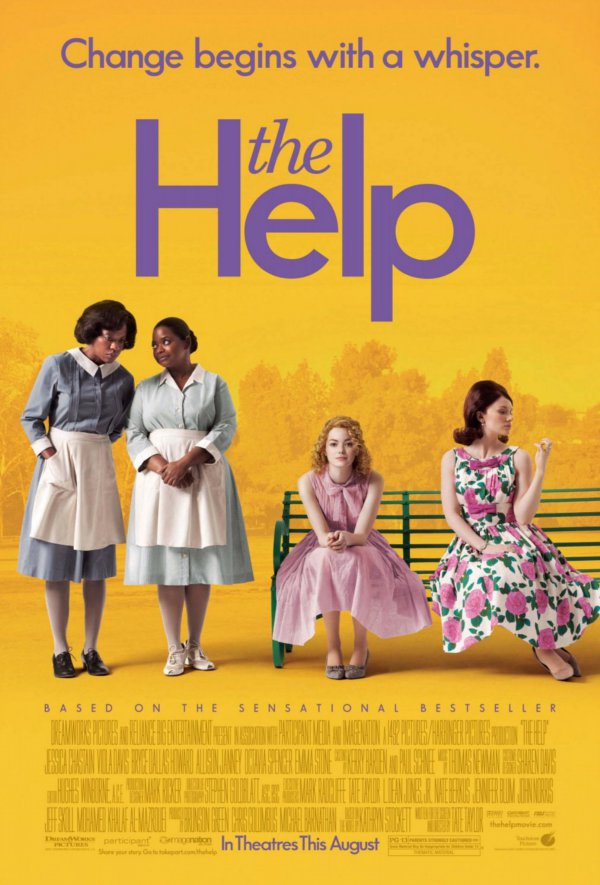
A few months before Kathryn Stockett’s debut novel The Help came out, I was at my favorite indie bookstore, Warwicks, and they were abuzz about an advance reading copy they had of this new book by a new voice. You will love it, they told me. And she’s coming here when the book releases!
When your favorite indie bookstore is that excited about a new book, you listen! I went to hear Kathryn Stockett speak at Warwicks in 2009 before I had even read the book. She charmed and wooed us, the throngs of us packed inside the book store. I bought her book, she signed it to me, and I sent home and devoured it. It was my favorite read of 2009. And I blogged about then, of course.
So I was more than ready for the movie version, and near to hyperventilating when my husband and I got pre-screening tickets to see it this week, before it is released into the wild. I left the theater spellbound. I loved it. Can’t wait to see it again.
It’s incredibly difficult, I would imagine, to smush a 500+ page book into a 2½-hour movie. There have to be things in the pages of the book that can’t show up in the screenshots in the movie. But I have to say, I was amazed at how respectful the screenwriters were to Ms. Stockett’s story and her unforgettable characters. They had a fabulous story to work with, and characters bursting with originality, but still, to capture the story and characters we loved into the arena of the visual so well is a wonder.
I was drawn in at the get-go with the fictive world Dreamworks created. Maybe it’s because I was already in love with these characters, but honestly, wouldn’t that make me more critical of someone else’s interpretation of what they looked and sounded like? I loved the attention to detail, the camera angles, the costuming, the sets, the sound track, the way you could almost taste Minny’s fried chicken – and maybe even her chocolate pie, if you know what I mean.
Aside from the movie’s artistic gifts, the moral takeaway was soundly woven in every minute of film. Someone asked me after I had seen it if it was family-friendly. It depends on the age of the child, I said. The occasional use of the S word is integral to the story. It is not there for ratings. It is the story. But I wouldn’t hesitate to take a 12-year-old. In fact, every 12-year-old and older should see it. Children are the adults of tomorrow. They bring into their adulthood what they were taught in in their childhood.
The part of the movie that will stay with me the longest is Abileen cuddling the toddler child of the white woman she works for, assuring this blossoming human that she is kind, smart, and important. Every child needs to hear that. Every child. That’s where the end of racial prejudice will begin.
Every child needs to hear they are kind, smart, and important. They become what we tell them they are.
Pi Squared, Marshmallow Squared, too.

NOTE: You will want to read to the end, I promise you. You could win something fun. . .
Walk down the aisles of any major grocery store these days and every special display is heralding the all-American summer pasttitme of eating something you’ve grilled outside on your patio. I dare anyone to show me an endcap right now of pumpkin pie filling or cranberry sauce. Right now it’s all about hot dog buns and kettle chips and baked beans and marshmallows for S’mores.
The basics don’t change shape from year to year; that’s usually something you can count on. Hot dogs are perennially tubular, baked beans come in cans, chips come in bags not boxes. So imagine my surprise when I saw yesterday (while buying hamburger buns which are unquestionably round) that marshmallows for S’Mores are now square. The plugs are still available, but they are in the baking aisle for making Rice Krispie treats. The marshmallows in the BBQ aisle are square! I get it, of course. Graham crackers are square, Hersheys are square. Why not square marshmallows? But it kinda messed with my sense of nostalgia, looking at those foursided confections. I bet they look stoopid on a skewer, I thought to myself, angry that retailers trifled with cherised objects of my childhood.
I came home a bit disillusioned and commented on Facebook that the sky was falling, I mean, that marshmallows are now square. I was comforted by FB friends who assured me they do not look stupid on the skewers, they make a nice S’More and more importantly, that homemade marshmallows have always been square. Homemade marshmallows? Is there such a thing?
Yes, a good friend told me and reminded me that I have her recipe for them in the cookbook she gave me. So to the cookbook I went and there they were!! I hear once you’ve had a homemade marshmallow you will never want a store-bought one again. So now of course, I must try them. I need to go shopping though. Hey ! Let’s all try them and share the love here. Yes! KEEP READING! Here’s my friend Linda Letellier’s Homemade Marshmallows:
4 envelopes unflavored gelatin
1 1/2 cups water, divided
3 cups sugar
1 1/4 cups light corn syrup
1/4 tsp salt
2 tsp vanilla
powdered sugar
Oil a 9×13 baking dish. Line with file and lightly coat with more oil. In a large mixer bowl sprinkle the gelatin onto 3/4 cup of the water. Let stand to soften.
Place the sugar, corn syrup, 3/4 water and salt into large heavy saucepan. Bring to a boil and cook until the syrup reaches 240 degrees F on a candy thermometer. Add the vanilla.
With beaters at full speed, beat the syrup slowly into the gelatin and continue beating until mixture is stiff, about 15 minutes. Pour and push the mixture onto the foil-lined pan and smooth the top. Allow the mixture to rest, uncovered, at room temperature, 10-12 hours.
Sprinkle a board with powdered sugar. Turn the stiffened marshmallow mixture out onto the sugar. Remove the foil. Sprinkle with more powdered sugar. Cut into squares, roll each surface in more powdered sugar and put into airtight container. They keep only a few days at room temperature, but you can keep them frozen for months. Also, instead of just cutting them into squares, you can cut them into shapes with oiled cookie cutters.
I feel a contest coming on! Make Linda’s marshmallows. Send me a JPG at susan [at] susanlmeissner [dot] com. I will post the pictures to the blog, unnamed, on July 4. The winner with the most amazing square or non-plug shaped marshmallows – voted by you fine people – will win an advance reading copy of my next book, A Sound Among The Trees, which doesn’t even hit shelves until October!
(The book is rectangular by the way, just like all the rest.)
Let’s have your picures to me by midnight July 3, Pacific time. Go for it. I have the advance reading copies in my possession. You could be reading the new book by mid-July if you win.
Now if you’ll pardon me, I need to go buy a candy thermometer. I am thinking the one I used for grilling pork loin (which is tubular, in case you are interested) won’t work. . .